
Recent data reflects this shift. Working capital tied up across organizations continues to rise, with an estimated $761 billion locked up today, up from $707 billion just two years ago, and the gap is widening. Working capital inefficiency is no longer just a balance-sheet metric; it is a signal of how difficult it has become to see and act on cash across multiple banks and systems.
At the same time, many finance leaders still rely on manual processes to reconcile and understand cash positions. Treasury teams spend more time managing liquidity flows and the operational side of cash than helping guide the business with strategic advisory. Individually, these challenges are manageable. Together, they point to a common issue: fragmented visibility across systems, banks, and workflows.
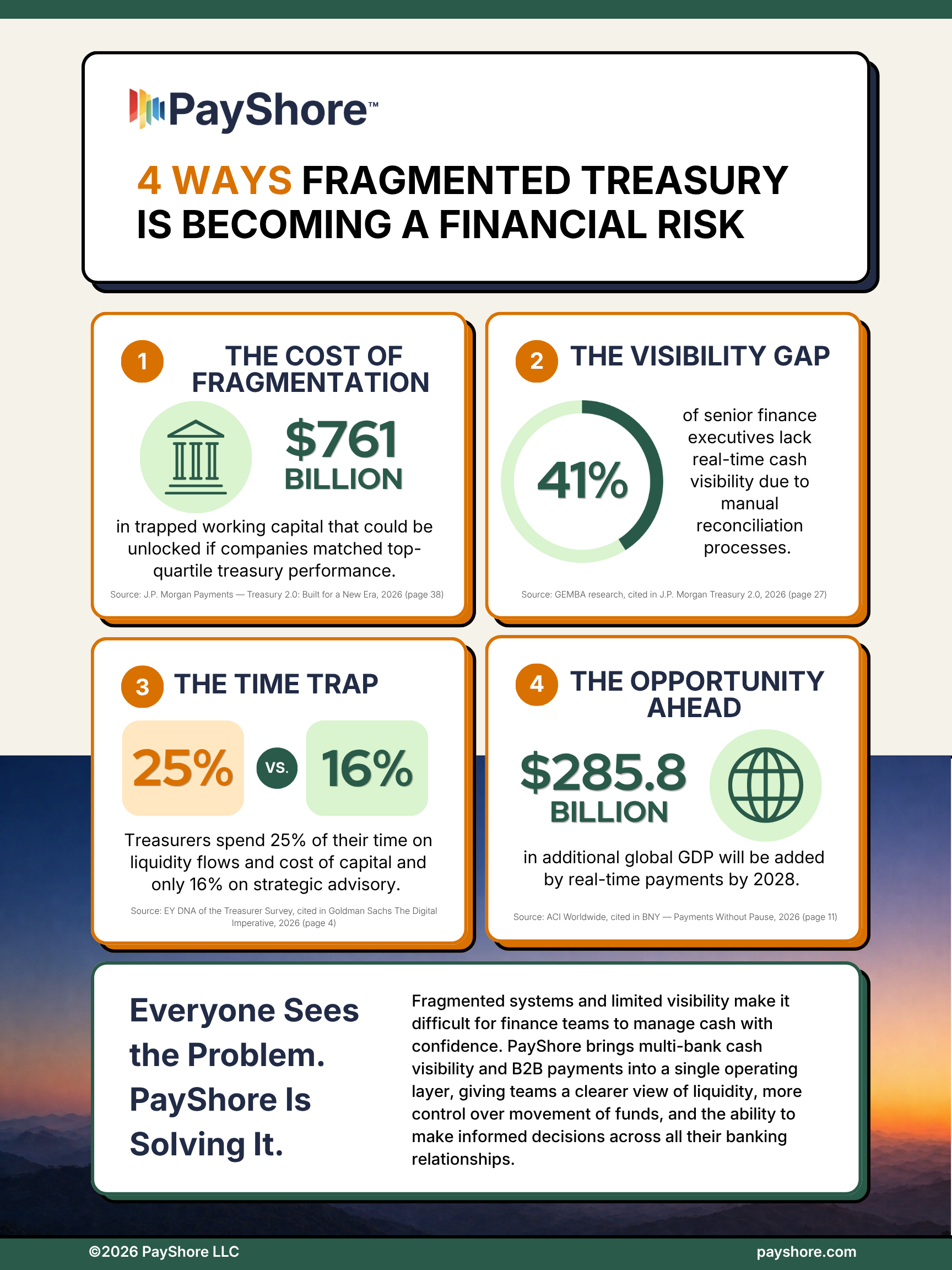 Four ways fragmented treasury is becoming a real financial risk — data drawn from J.P. Morgan Treasury 2.0 (2026), Goldman Sachs’ Digital Imperative (2026), and BNY Payments Without Pause (2026).
How can finance leaders navigate cash visibility challenges?
This becomes more relevant as payment speed increases. Real-time payments are expanding globally, raising expectations for faster decisions and tighter control over liquidity. When money moves faster, the ability to see and act on cash positions in real time becomes more valuable.
For finance leaders, the question is less about reducing complexity and more about navigating it effectively. Most organizations are not moving to a single bank or a single system. Instead, they are looking for ways to bring greater consistency and visibility across the banks and technologies they already use.
The data in this infographic highlights a few of the forces behind this shift, from rising working capital levels to the continued reliance on manual processes, and why visibility is becoming a more central focus for treasury teams.
For finance leaders, this means visibility is no longer a back-office reporting issue. It is central to how the organization manages liquidity, supports growth, and navigates change.
Why fragmentation is compounding, not fading
Over the past few years, the banking and payments industry has accelerated adoption of real-time data transfers and payment rails, often through APIs. At the same time, treasury responsibilities have expanded, banking relationships have become more distributed, and expectations for real-time insight have grown faster than most teams’ budgets and tools.
The three recent reports highlighted in the infographic point to the same underlying pattern:
- Treasury and finance environments are becoming more real time.
- Real-time payment rail adoption is increasing across markets.
- Banking relationships and data sources are more fragmented than before.
- Treasurers have less bandwidth to deliver more strategic insight due to the increased time it takes to complete operational workload.
How PayShore fits into the picture
PayShore was built in response to these trends. The goal is to simplify complex treasury and payment workflows while keeping data safe, secure, and accessible in one place. By bringing together multi-bank cash data and payment flows into one operating layer, it helps teams see their positions more clearly, manage liquidity with greater confidence, and make faster, better-informed decisions.
To learn more about how PayShore approaches multi-bank cash visibility and B2B payments, explore our Product page or see how the platform is used across different use cases.